Showing posts with label Bord 214. Show all posts

Sunday, June 29, 2014

MI-2, Bord 214 update 6/27/14


With the transmission back in place, the turbine engines have been reinstalled.  As with the transmission, the bright colors on the engine components help give the bird a "like new" appearance as it goes back together. But the colors are only a small expression of the work and attention to detail given to the process.


It seems like all aircraft (especially helicopters) are required to have one or more tight spaces where something has to be checked or connected.  Even with access panels removed long and skinny arms and fingers are often desirable and sometimes required. With the intake preheat not yet installed on the right engine, a moment of such "tight squeeze concentration" was captured above.


This front view shows one of the specialized pieces of standard field equipment, a ladder-bridge, used to access the front of the engine compartment over the nose of the aircraft.

The four forward facing air intakes are prominent in this view.  The center square opening (where a head is inserted above) is covered by a grilled panel after work is completed. Left and right of the square opening are the turbine intakes and the large round opening on top feeds the radiator assemblies in the transmission compartment.


As the exterior was restored, so were the markings and insignia. The red alignment indicators for the dzus fasteners allow visual confirmation during preflight that the compartments are closed and locked.


This Red Star-Roundel combination (appropriate for the period prior the breakup), was run through a computer program in order to match it to the curved surfaces underneath.

Monday, June 23, 2014

MI-2, #214 Status Update


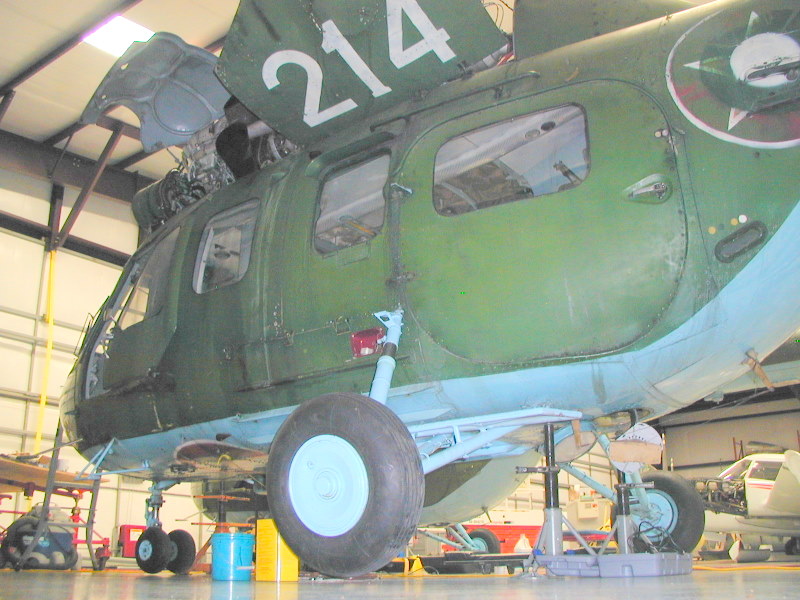
After the start of a dark  and dreary rainy day (somewhat of a rarity here in sunny Texas),  the rain stopped and the sun came out so we were able to open the hanger doors and remount the transmission on #214 (shown here with #213 in the background).


The fuselage of 214 has been completely stripped and repainted. After years and years of service this transmission compartment has not been this clean and shiny since it was at the factory (and maybe not even then).


After an emergency call to get the venerable forklift into operation (a vertical lift beast of its own kind),  the transmission was rigged for placement under the watchful eye of museum directors and volunteers.


Of course like all good things helicopter, the transmission could not simply be "dropped" into place. After achieving near perfect vertical and angular alignment, the twin turbine drive shafts must be guided through tight bulkheads into the turbine compartments while at the same time the control rods, cables and connections are guarded or guided into position. With a generous application of attention and a few words of persuasion, the transmission was soon in place.


As the sun sets over the Texas prairie a transmission once again sits atop #214. The persnickety drive shaft for the left turbine is visible through the bulkhead in this photo illustrating the place, mate and "slide" 3D puzzle referenced in the photos above.

As #214 progresses back into service, we hope to provide a new series of restoration posts as before.


Sunday, March 8, 2009

Reshuffle the Deck

Project management at the museum is challenging. In a strictly linear world, projects would be started one at a time and work would then follow a fixed schedule until completion. Only after the completion of project A would project B be started, and so forth. Fortunately (or unfortunately, depending on your point of view), the museum operates on a much more flexible basis. We are constantly adjusting priorities and work areas because of factors beyond our control.

As work on a restoration progresses, we may uncover problems that require special parts, additional work or special support people. Waiting on parts, scheduling special repairs and working around busy schedules with limited resources (and resources are always limited) requires a flexible attitude and quite a bit of composure.

Many of our projects are overlapped to avoid down time while we are waiting on parts for other projects. We also usually have a number of small work groups working simultaneously on different projects, either because of their interest or specialty. These different interest groups then join together and assist each other as needed.

The Mi-2 work area has been reshuffled as we reversed the work order on these birds. While not as busy or dangerous as a carrier deck, even our aircraft movements require planning and care. Once an aircraft is up on jacks, it cannot be moved easily to make room for another aircraft to get by. We had that fun experience recently getting the Twin Commanche out when its annual was completed and it was needed for an important trip. And any aircraft movement in a crowded area always runs the risk of damage to an aircraft.

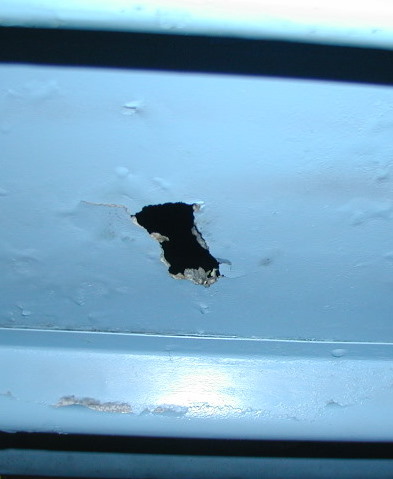
In a previous post, we reported that repairs had been started on Mi2, Bord 214. When we removed the fuel bladder, we discovered that the damage was more extensive than we had anticipated. Removing the fuel bladders from the other Mi-2's gave us a better idea of all the repairs needed, as well as how many replacement bladders to order. The reshuffle moved 214 off the jacks and to the back, while 213 was moved up as the next primary Mi-2 project. Repairs to 214 will require metalwork as extensive, or possibly more so, than the repairs that were performed on Bord 211


A view inside #214 (and a closeup) after the fuel bladder was removed

Sunday, January 18, 2009

Mi-2 #214 repairs started


As covered in the story about #211 (see previous Mi-2 posts), the bottom skin of #214 must also be replaced. The picture on the left shows an area where corrosion has eaten all the way through. The fuel tank (bladder) has already been removed from the aircraft and after an inspection of the compartment and structure, the extent of the area to be repaired will be determined.

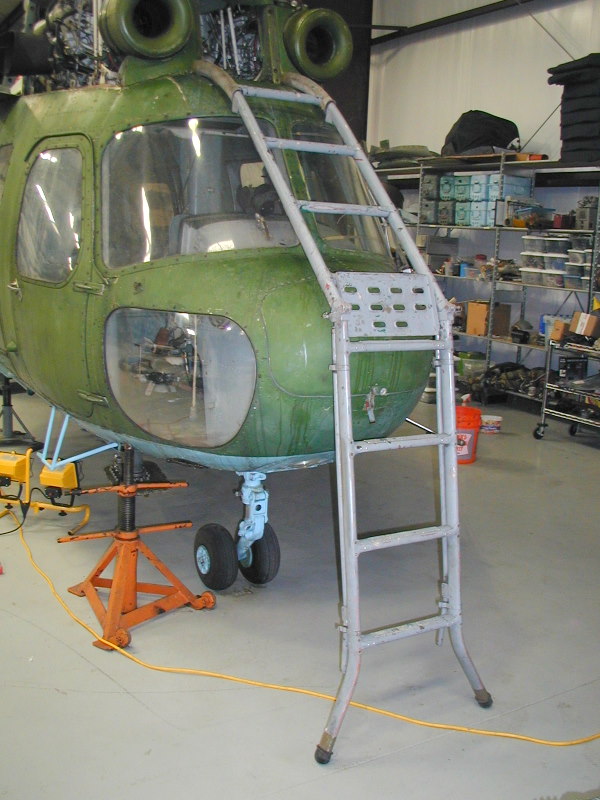
A special ladder, part of the ground equipment, makes access for cleaning and inspecting the engine compartment easier.