A couple of
CWAM associates had the pleasure of attending and reporting back on the
Red Bull Air Race event held in our area this weekend. Pictures are from Saturday, when training and Challanger class events were held. Between the Challanger and Master Class events, it appeared teams were competing from about 17 different countries from around the world.
During the Cold War, air shows and "civilian" air race competitions were an opportunity for national interests to be displayed in a highly competitive atmosphere, sans weapons. In contrast to that era, all of these teams appear supported by commercial, not national, interests. But it is still fun for the spectators to root for their home teams.
The
Texas Motor Speedway is a unique venue for this event. The Speedway normally hosts NASCAR automotive races and was built "Texas sized" to reflect the public interest and following of those events. The speedway is capable of seating and supporting more than 128,000 visitors. And a hotel provides spectacular views of race events. The extensive parking area is filled with buses, motor homes and campers on multi-day events.
The entire course is visible from the speedway stands. Take offs and landings were also from within the stadium, puting all of the action in direct view of the spectators.
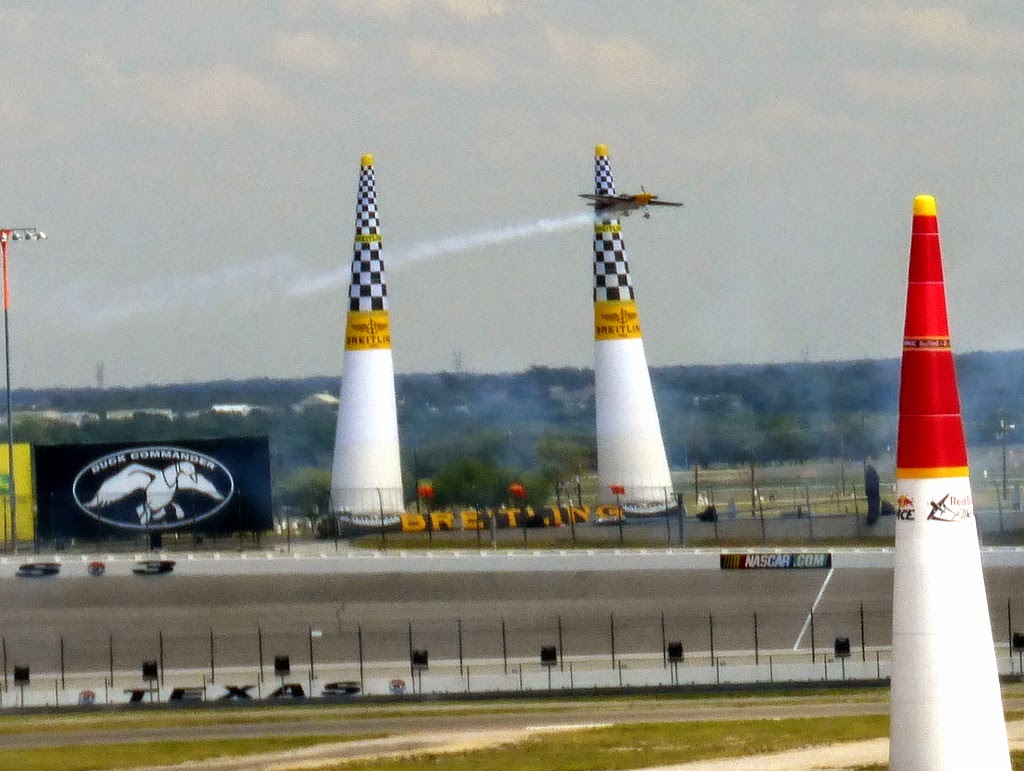
Smoke on! Flying directly towards the main viewing area,entry is made between the checkered pylons. The "pits" directly in front of the spectators, where race cars are normally housed serve as open hangers for the event.
Prior to competition, viewers got a good look at each plane, as it was pushed by hand across the front of the stands to a marshaling area.
Where it could be checked and started.
Then depart and stage for its scheduled run.
Between heats, returning aircraft land in front of the spectators.
After parking their aircraft, pilots exhausted by the Texas heat and G forces may go to press or conference rooms for interviews, or back to the pits for debriefing.
During the event, spectators could watch the planes flying in front of them or watch the action on a giant screen across the field. The screen switched between cameras inside the aircraft, views from cameras mounted on the aircraft and views from cameras in the stadium and a helicopter above. The display also showed times, speeds and rankings of the aircraft/pilots. The bright flash of Texas sun shown on the big screen behind the pilots head is a reminder of another obstacle the pilots faced during the race.
Entry through the checkered pylon gates was followed by an immediate turn to the left towards the first red pylon. Aircraft had to make entry under 200 knots, most entered on a slight decent to add speed after entry.
Clipping a pylon adds a time penalty. The top of the checkered entry pylon can just be seen behind this aircraft's tail as the pylon begins to collapse. Crews on the ground could repair and re-inflate a pylon in a matter of minutes.
Part of the purpose of the training rounds was for pilots to learn the course, many flew the course faster or with smoother manuevering on their second pass.
The course is short and fast. After passing the first red pylon the aircraft passes in front of the stands. The jumbo display in this shot is showing a slightly out of sync view from a camera mounted on the aircraft's tail. The speed of action is intense and you can watch the moving plane or the stationary screen, but not both at the same time. The slight lag in attitude shown on screen, compared to the aircraft in flight, was only noticeable looking at this shot after the fact.
Continuing down course, the aircraft goes vertical to reverse direction. In this shot, the right pylon of this pair was hit on the first Lap and is laying on the ground. Between heats, a crew repaired and re-inflated it in about two minutes. The spectators lining the hotel top floor balcony must have a great view.
Over the top,
and down again.
Fly through another set of pylons,
out between a pair at the North end, do an immediate 10G turn of about 240 degrees,
and come back in again to complete Lap 1, repeat for Lap 2.
At the end of Lap 2 pull-up and reverse to exit, while they put your picture on the big screen and the crowd cheers. Be sure to smile for the camera. Got it?
A great event, we hope they come back again and we hope you enjoyed the pictures.