With so many projects ongoing at the
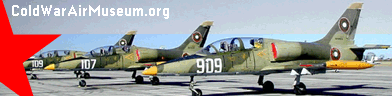
Cold War Air Museum, some inevitably get delayed longer than others. The assembly of this
L-29 actually started several years ago, but was put on hold when a fuel leak was discovered. Knowing that the aircraft would have to be disassembled to find the leak, the project was set aside until time and manpower became available.
This weekend, we were fortunate to bring the resources together that were needed. After demating the nose section and removing the front fuel tank, the leak was found.
The leak was not visible through any of the various inspection openings. While it was hoped that it might simply be from a hose, connector or seal that could easily be tightened or replaced, replacement front and rear fuel tanks were readied, just in case.
As it turned out, one of the tanks was indeed the culprit. Water, the natural enemy of aircraft, had accumulated in the bottom of the front tank and over the years, corrosion had taken it's toll.
As always, when an aircraft is opened up, a thorough inspection and cleaning took place.
With no other damage found, the front compartment was made ready to accept the replacement tank.
The new tank is carefully guided into place. The front tank has channels on each side where air ducts feed the engine from the wing roots. The rear tank has a "doughnut hole" in the center where the air passes through to feed the engine intake.
With the tank installed, the nose is remated to the center section. Having the necessary equipment makes the job easier. While the nose was supported and moved on a wheeled nose dolly, the center section was supported by jacks as the tail rested on a tail dolly. Each piece is a standard piece of L29 ground support equipment.
In addition to the numerous cables, controls, pneumatic and hydraulic connections, the nose section is structurally attached to the center section by a ring of (many) bolts reached through the rear cockpit and lower fuselage. Here Mike is shown working up a magic combination of extensions to get to the bolts.
The best man for the job did not have much room to work in. Unfortunately it seems like aircraft designers often expect techs to be impossibly small and limber, with extra long arms and at least six fingers on each hand to wiggle things into places they can't see.
While the aircraft was up on jacks, it was also a good opportunity to replace tires and check the brakes.
Brad makes quick work of the job, this bird is now ready to stop and go. The main tires on the L29 are the same as the main tires on the Mi-2, so one stock of consumables provides for both.
While the old tires showed normal wear for the aircraft, one of the tubes was creased. The new tubes were installed with care (and talcum powder) to ensure that the new tube could expand evenly when it is first inflated.
This picture is not what it looks like. Larry is NOT about to grease Zach's face. Instead, Zach is simply monitoring as Larry applies grease to some of the many fittings found throughout the gear system.
With lots of coffee needed to fuel the workers, the L29's IFF compartment became an impromptu table. With both the fixed wing and helicopter group working on the project to meet a tight schedule, a great deal was accomplished in a short time. This project looks like it is going to be a resounding success, with everyone looking forward to taking a ride in Bord 41 soon.


 The Unit and ID markings on these working aircraft stored outside were well faded.
 These original markings are being replaced and renewed by one of our museum associates. The training command to which this aircraft belonged used an Eagle painted on the nose to designate their aircraft.
 Abel has taken on the task of renewing these markings, including the Eagles on both sides of the nose. Although we obtained the original template from the base when we acquired their parts inventory, it is too worn to give a sharp rendition. Here he is making sketches to compare to the template and aircraft before deciding how to proceed.
  After making his sketches, Abel cut a new template for evaluation and made a test image on a piece of plastic sheeting. The final template and harder surface of the aircraft will yield a sharper image.
 Here he is meticulously removing the old paint to restore an L-29, Bord 41 to its original military colors.
 The tip of the nose has been redone and the old anti-glare paint in front of the cockpit has been removed and a new layer applied. Next will come numbering and restoration of the eagle on the side of the nose.