Showing posts with label L-29. Show all posts

Sunday, July 17, 2011

Cold War Air Museum L-29 Delfin Projects

The Cold War Air Museum is fortunate to have a number of friends and associates that help support the museum. Part of this growing network includes a number of L-29 pilots and aircraft owners.

Many of these fine Delfin Trainers were imported, but some were never reassembled or flown. Even with the best of intentions, there sometimes is simply not enough time in the day to do everything a busy person wants to do. With the price of Jet fuel high and the economy low, several such projects have been offered or donated to the Museum.

Moving and storage alone places significant demands on Museum resources. Brad, who has taken a lead role in a number of projects lately, is shown rigging an L-29 center section for local transport. The cradles and frames shown in these pictures were originally used for the overseas shipment of the aircraft. Chris (with an appropriate western hat), stands by to help.

This particular nose section came from a base that also provided training and support for MiG-23's, as indicated by its nose art.

For many of the volunteers, this was their first opportunity to see an aircraft in pieces, as it was originally shipped. For others, it was a familiar experience, having moved dozens of similar projects in the past.

Machinery helps, but is not always available or necessary. Here, a set of L-29 wings is being moved by hand. Approaching a downhill section on the ramp, Homer stretches his legs to stay ahead of the rollers. Tales from Eastern block crews that worked on these aircraft contain numerous anecdotes about maintenance in countries and on bases, where equipment we take for granted was not always available.

Rene, Larry and others assisted as well. Equipping this golf cart with drop tanks did not significantly increase it's range. We're working on providing training for that as an L-29, mod-golf-cart (dash-1), issue.

With recent improvements in housekeeping, we were able to accommodate storage for three more projects (in pieces). Our goal (one on a list of many goals), will be to continue to restore and fly such aircraft in support of the educational and historical mission of the Museum.

Post WWII, there were tens of thousands of surplus aircraft on airports and in hangars across the U.S. Now, there are only a few hundred left in flying condition. The "mature" generation at the Museum watched as those aircraft and their history disappeared forever. Thus we appreciate the value of rescuing and recovering aircraft from "our" era for future generations to enjoy.

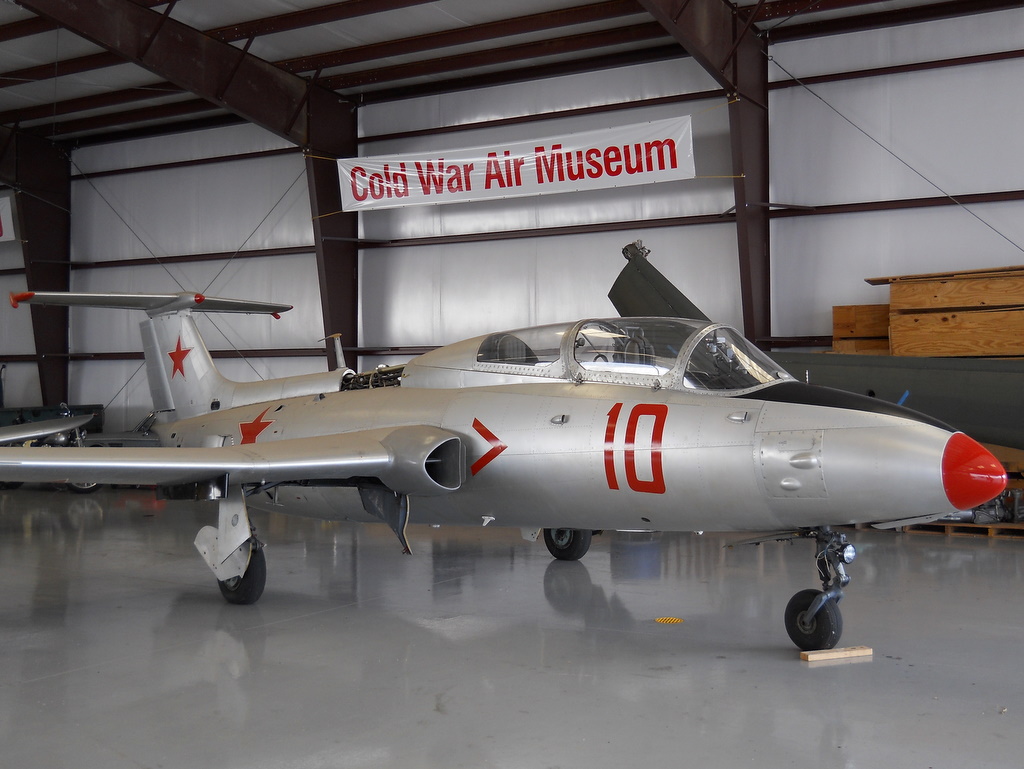
Bord 10, the aircraft hidden in the picture above, now hopefully heads for a new home.

Cosmetically restored at its prior home, we hope more importantly that this aircraft can again regain flight with the Museum's parts and maintenance resources for support.

Thursday, April 7, 2011

"Moving right along", an L29 story

A recent series of hanger relocation's around the Cold War Air Museum brought an L29 project temporarily out of storage.

One of the interesting stories for a future post is about how these aircraft were taken apart and shipped from their original homes to Texas.

The L29 divides easily into five major sub-assemblies, the nose, tail, wings, mid-section and engine (plus some extra parts).

The mid section, shown above, is the key puzzle piece. After you attach the nose, lower the gear and mount the engine, you have something that looks like a tricycle speed racer, useful for basic engine checkout and test. Wings, tail and a horizontal stab then complete the puzzle.

More than ten of these classic jet trainers have been reassembled or brought back to flying status with the assistance of the local group of fliers and mechanics.

The nose section contains the pressurized cockpit. Until the aircraft is reassembled, checked and certified, the owner can only sit inside and make loud "whooshing" noises. With today's fuel prices that sometimes seems like a desirable alternative even for the fliers.

Sunday, February 27, 2011

L29 Delfin Smiles

Some of the recent work at the Cold War Air Museum has focused on bringing one of the museum's L-29 projects up to flying status.

The group working on Bord 41 pauses in front of the aircraft to smile about how the work is progressing.

The sound of jet engines is a happy sound to the volunteers and to the airport fuel concession.

A total of four L29's were brought out, started, taxied or flown (several at the airport are already licensed and flying) over the weekend.

Following one of these engine and taxi tests, the photographer got the chance to get (almost) everyone in front of Bord 41 for the lead picture above.

Work will continue on the aircraft until it's successful airworthiness inspection, scheduled for the near future.

Sunday, February 20, 2011

L29 Delfin Soon to Fly

With so many projects ongoing at the Cold War Air Museum, some inevitably get delayed longer than others. The assembly of this L-29 actually started several years ago, but was put on hold when a fuel leak was discovered. Knowing that the aircraft would have to be disassembled to find the leak, the project was set aside until time and manpower became available.

This weekend, we were fortunate to bring the resources together that were needed. After demating the nose section and removing the front fuel tank, the leak was found.

The leak was not visible through any of the various inspection openings. While it was hoped that it might simply be from a hose, connector or seal that could easily be tightened or replaced, replacement front and rear fuel tanks were readied, just in case.

As it turned out, one of the tanks was indeed the culprit. Water, the natural enemy of aircraft, had accumulated in the bottom of the front tank and over the years, corrosion had taken it's toll.

As always, when an aircraft is opened up, a thorough inspection and cleaning took place.

With no other damage found, the front compartment was made ready to accept the replacement tank.

The new tank is carefully guided into place. The front tank has channels on each side where air ducts feed the engine from the wing roots. The rear tank has a "doughnut hole" in the center where the air passes through to feed the engine intake.

With the tank installed, the nose is remated to the center section. Having the necessary equipment makes the job easier. While the nose was supported and moved on a wheeled nose dolly, the center section was supported by jacks as the tail rested on a tail dolly. Each piece is a standard piece of L29 ground support equipment.

In addition to the numerous cables, controls, pneumatic and hydraulic connections, the nose section is structurally attached to the center section by a ring of (many) bolts reached through the rear cockpit and lower fuselage. Here Mike is shown working up a magic combination of extensions to get to the bolts.

The best man for the job did not have much room to work in. Unfortunately it seems like aircraft designers often expect techs to be impossibly small and limber, with extra long arms and at least six fingers on each hand to wiggle things into places they can't see.

While the aircraft was up on jacks, it was also a good opportunity to replace tires and check the brakes.

Brad makes quick work of the job, this bird is now ready to stop and go. The main tires on the L29 are the same as the main tires on the Mi-2, so one stock of consumables provides for both.

While the old tires showed normal wear for the aircraft, one of the tubes was creased. The new tubes were installed with care (and talcum powder) to ensure that the new tube could expand evenly when it is first inflated.

This picture is not what it looks like. Larry is NOT about to grease Zach's face. Instead, Zach is simply monitoring as Larry applies grease to some of the many fittings found throughout the gear system.

With lots of coffee needed to fuel the workers, the L29's IFF compartment became an impromptu table. With both the fixed wing and helicopter group working on the project to meet a tight schedule, a great deal was accomplished in a short time. This project looks like it is going to be a resounding success, with everyone looking forward to taking a ride in Bord 41 soon.

Sunday, March 7, 2010

Feature Associate, New Director Andre Plaskota

Recently we elected another new director at the Cold War Air Museum.

Andre is a local businessman who frequently flys his Piper Cheyenne on extended business trips. Andre is also a long time partner in one of the L29's on the field and actively participates in various airport activities.

68SJ was featured in one of our earlier posts. We appreciate Andre's support and look forward to his participation at the museum.

Monday, January 11, 2010

The Aerovodochody L-29, a cold war era jet trainer

The associate that started all the local jet warbird interest talks about the Aerovodochody L-29 and how the first aircraft came to Lancaster before the Cold War Air Museum was formed.


Thank's Roma!

A number of L-29's are based at the airport and associated with the museum. For more stories, click on the "L-29" label below. Come see an L-29 "in real life" at the Lancaster Airport near Dallas. The museum is open every Saturday.

(bumped — video with improved audio posted)

Sunday, November 22, 2009

Supersonic Cowboys - Captain Ron Knott

The F-8 Crusader was the first operational fighter with a top speed in excess of 1,000 mph and the last American fighter with guns as a primary weapon.

Ron Knott, author of Supersonic Cowboys, a compilation of stories about the valiant F-8 and her pilots, found us this weekend.

Ron's book is available through his web site, where more information can be found about Ron, his book and his support for our country. We appreciate Ron's visit and we honor Ron and all those whose stories are told in Supersonic Cowboys.


Ron's son Kerry, a private pilot, got a taste for fast flight in an L29 trainer. As a flying museum, we value seeing this kind of experience passed from generation to generation.

68SJ is one of the L29's actively flying at Lancaster. Currently there are four U.S. licensed L29s with eight rated pilots based at the airport. No longer showing her Bulgarian colors, Bord 45 is now painted in a unique design created by her local pilot team.

Following Kerry's flight Sunday morning, another group arrived Sunday afternoon. On those occasions when someone has the opportunity to fly with one of the pilots of these aircraft, friends and family may come to share in a unique, generally once-in-a-lifetime, experience.

These kids are sharing dad's fun along with other family members through 68SJ's on-board cameras.

This kind of second life for these former soviet block jets could hardly have been envisioned by their designers and former flight crews.

Thursday, November 12, 2009

History of the L-29 in Bulgaria

Given the significant number of L-29s in Lancaster, associated and especially ex-Bulgarian L-29s I thought it would be interesting for everyone to read a bit about the history of the trainer jet in Bulgaria...

It all began in 1963 when a proposal for a new jet trainer was made involving three different designs. The Polish PZL-11 “Iskra”, the Soviet Yak-30 and the Czech L-29 Delfin. It was decided by the “powers that be” that the L-29 would be the future trainer jet for all Warsaw Pact countries. Interestingly enough, Poland still ended up using the “Iskra” which is still in service today under the designation TS-11. Since the L-29 ended up the winner, mass production and deliveries soon began. They began to arrive in Bulgaria in the summer of 1964 and were immediately transferred to Kamenetz airbase, where the command staff of instructors of the 2nd aviation training regiment began to use the new aircraft with the assistance of Soviet instructors. 6 L-29s were delivered by the end of that year with the first with construction number № 491028 and bord number “11” delivered on July 21, 1964. The initial entry into service was with high intensity but went very smooth. On one hand this was due to the excellent preparation of the Bulgarian pilots, having long experience of the relatively sophisticated fighter jets MiG-15 and MiG-17, but another reason was the excellent qualities of the new plane. At the same time the flying school at Dolna Mitropoliya started preparing to be the main airbase that will be operating the L-29. Freshman cadets in 1964 began receiving training to prepare for the new aircraft. This is the first class in the country which began initial study of the L-29. The first flights with cadet pilots using the L-29 began in May 1965 by which time the number of aircraft received increased by another 12 machines. Intensive flights ran from June to October during which time students began to fly alone and perform complex aerobatics. The experience gained after these relatively few hours allowed cadets to begin flying the MiG-15 and MiG-17 in Kamenetz. This first graduating class (class of 1968) is unique in the fact that it was the first class to start training on the L-29. During that time all pilots completed the program successfully with no accidents or crashes and had an average of over 300 flight hours. Eight of the pilots remained to continue their service as instructors of the new aircraft. By this time in 1968 the total number of L-29s in Bulgarian service is 52. The next class marks milestone of L-29 operations in Bulgaria. Cadets underwent theoretical training at Shtraklevo airbase and flight training at Dolna Mitropoliya airbase where they performed flights simulating attack of air targets which is the first time this has been done.

A couple of photos of Bulgarian L-29s pre-1989. Note the stars:


By 1970 the total number of L-29s had reached 82 with 2 squadrons of L-29s at Shtraklevo and another 2 squadrons at Dolna Mitropoliya. As supplies of the Czechoslovak trainer increased this required a greater quantity of instructors and 38 of the 44 pilots of the class of 1970 remained as instructors. This class was the first to perform flights at night in simple weather conditions. At the same time the installation of the first TL-29 simulator was completed at Dolna Mitropoliya airport. The L-29 continued proving itself as an excellent and reliable trainer which provided opportunities for the preparation of cadet pilots for more complex tasks. During the winter of 1971-1972 cadets successfully completed a program involving flying in complicated meteorological conditions (cloud lower limit of 300m(900ft) and visibility 3 km). Additional training was completed in conducting aerial reconnaissance and ground target training using unguided rockets and bombs. This now allowed the L-29s to be used in actual armed conflict, if need be. To increase firing capabilities, attempts were made to mount a 7.62mm machine gun in the bow of the aircraft. The experiment was successful and one L-29 had such weapons, serving for many years for practicing shooting at ground targets.

Bord 78 and 113 both of which were sold to the USA after retirement:


The L-29 fleet was extensively and effectively demonstrated several times on special occasions. The biggest of these was the flight of 63 L-29s in formation on September 9, 1974 during a military parade in Sofia where the party and state leaders watched. The planes in formation spelled out “30 НРБ”. This stood for 30 NRB or 30 Narodna Republika Bulgaria (People's Republic of Bulgaria). The celebration was the 30th anniversary of the establishment of the Bulgarian Communist party. In a perfect array, 63 L-29s at a speed of 350 km /h and altitude of 1200m passed over the city center becoming one of the largest shows of Bulgarian air power and putting to shame any formation put on by the Blue Angels. Several other similar formations were done during the years including one which showed "25" instead of "30" on September 9, 1969 but without the "NRB" letters.

Poor quality but interesting photographs of the 63-plane formation spelling out "30 НРБ":


Contrary to what this MAY look like, this is in fact a 21-plane formation of L-29s resembling a rocket and celebrating the first astronaut Yuri Gagarin. April 12, 1974:

The curriculum remained unchanged until 1988 which meant that cadets received about 100-200 hours in the L-29 upon graduation. Additionally the flying school “G.Benkovski” at Dolna Mitropoliya began training pilots for the needs of civil aviation, which also received their initial training of 50 hours on L-29s. Between 1977 and 1995 270 civilian pilots were trained that went on to fly in the national airline “Balkan”. Also between 1979 to 1984, 13 Vietnamese and 18 Nicaraguan pilots were trained on Bulgarian L-29s. L-29s served until they were retired on June 11, 2001 ending an almost 40 year history with the Bulgarian air force. In the 1990s L-29s were dispersed to various airbases besides Shtraklevo and Dolna Mitropoliya. Shtraklevo itself was closed in 1998. Some of these airbases included Balchik, Ravnetz and Dobroslavtzi.

The specially painted L-29s of the aerobatic group formed in the 1990s which performed at various airshows:


During the period between 1964 to 2001 a total of 109 L-29s were delivered with consecutive bord numbers from “11” to “119”. The aircraft had an average of 4000 hours each. The L-29 was extremely reliable and easy to fly as shown by the good safety record. Only 4 airframes were lost during 37 years of extensive operations. The first serious incident was on November 18, 1971. While trying to perform a routine reconnaissance training flight the aircraft descended below the minimum allowed altitude and crashed with the death of both pilots. For the same reason, two instructors were killed on June 14, 1972. One of them is lieutenant Chavdar Djurov the son of the minister of defense. On August 4, 1974 during a formation flight an L-29 piloted by sergeant Stefan Stefanov hit the lead plane. Instead of ejecting, he attempted to fly despite the resulting damage and crashed. In 1979, 1982 and in 1983 there were three registered cases of in- flight engine compressor destruction. In the first case, the debris of the destroyed engine cut the engine controls after take-off at a height of 6 meters and the plane collapsed on the runway breaking in two and catching fire but the pilots were saved. In the latter two cases, the altitude was considerably higher and the pilots used the excellent aircraft aerodynamics to glide to an emergency landing. After retirement, many aircraft ended up being sold to foreign private operators as is the case with many L-29s at Lancaster. Some L-29s became preserved throughout Bulgaria one of them being the first L-29 delivered. Bord 11 can now be seen preserved at the air force museum at Plovdiv airport. Other L-29s have an unknown fate but were probably scrapped.

A short amateur vintage video of the specially painted L-29s performing at an airshow in 1992:


More pictures L29's at Lancaster are being added to the Cold War Air Museum web site.