Monday, July 13, 2009

Hot, Hot, Hot

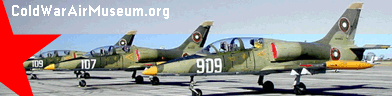
One of the museum's L-39s, Bord 107, has been running high EGT (exhaust gas temperature) for some time. The L-39 has an EGT limiting circuit that illuminates a warning light at 700°C... and should the EGT reach 730°C in flight, the engine will automatically be shut down when the nose-wheel touches the ground. (No go-arounds possible!)

A "730" event is very serious in nature and requires an inspection to be performed before the secret reset button (location not divulged to pilots) is pressed and the engine can be started again.

Bord 107 was regularly seeing the 700°C light flash on take-off and the situation was mitigated by pulling the throttle back a bit. But too much of that and the turbine will start spitting blades out the back.

Soot buildup in the combustion chambers eventually disturbs the flame pattern, causing the combustion to continue as it moves further back. Flames licking at the EGT probes behind the engine gets the warning light to start screaming, "Ow! You're hurting me!"

Over time the ventilation holes in the inner jacket get, as our very German adviser says, "stuffed like little bratwurst". Lack of good air flow prevents a good clean burning of the fuel.


The problem initially manifested itself as a drop in the HPC (high pressure compressor) RPM. Our Czech mechanic had adjusted the fuel controller to put a little more fuel in to bring the RPM back up. That brought the RPM back up, but the EGT came up with it... in effect, it only made the problem worse since extra fuel burned even longer and even farther back in the compressor area.

One indication of this problem is flames in the exhaust at high power. Our adviser, Bernd of Aero Contact, sent these graphics to illustrate what to look for:


Taking a look at Bord 107, that's what we saw — and Brad has a whole new respect for jet exhaust! Fortunately, there is a solution, although not a simple one.

The first step was to send all the instruments to Bernd in Germany to have them inspected and calibrated; it simply wouldn't be possible to get to a "correct" solution without accurate readings on the instruments.

So out they came...


And off they went...


After Aero Contact's analysis, the instruments were judged to be in tolerance, although the front and rear RPM indicators need to be swapped so that the more accurate one would be in the front cockpit.

Historically there have been a number of ways to deal with soot buildup in jet engines. One of the simplest ways to clean an engine is to fly through heavy rain. The scrubbing effect of the water and steam will do wonders for a mildly dirty engine. Rain water has the added benefit of having a very low mineral content, so it's much better for the engine than tap water. Another simple method was to bring the engine up to speed and throw a small amount of ground Walnut shells (yes, WALNUT SHELLS) into the engine. While this worked reasonably well for centrifical flow engines, it doesn't work quite as well for axial flow engines... and a hard chunk of walnut shell can do more harm than good.

The more modern method is to spray a solvent into the engine in one of two methods, either OFF-LINE or ON-LINE. Off-line (or "crank washing") an engine consists of "cold" rotating the engine at 20-25% RPM and soaking it down with solvent. On-line washing injects the solvent while the engine is actually running at about 90%. Using both methods together generally results in a good cleaning.

Caustic solvents were originally the preferred detergent for cleaning engines, but they were an EPA nightmare. A lot of chemical engineering has gone into producing water-based solvents such as TurboTect 2020 that are almost as effective as the old solvents and the effluent doesn't have to be carted off in a HazMat truck. The water-based solvents do a little better job on hardened salts but not quite as good a job on small (35 micron or smaller) particulates. A number of patents have been issued in recent years for solutions to this problem.

Bernd is sending a special injection tool to do crank washing deep within the compressor section. A few cycles of this kind of cleaning will reportedly bring the EGT down as much as 40°C and improve the power output by several percent.

The instruments, injection tool and a 55 gallon drum of solvent should all be here this week... and none too soon, it's hot enough in Texas!

Sunday, July 12, 2009

What's in a name?

Despite the best efforts of officials, an aircraft takes on a name and identity given to it by those who fly it and use it, not by those who design it or pay for it.

The U.S. Army has an official policy of naming helicopters after Native American (Indian) tribes. Despite the best efforts of publicists, no one calls this an Iroquois, everyone calls it a Huey.

The T-37, featured in the preceding post, is one of a handful of U.S. aircraft that were not officially named when they were "born". Another was the F-111.

Never officially named during its service career, the F-111 was always known by its unofficial nickname. At its decommissioning ceremony, the F-111 finally received an official name, the name those who had flown it and worked on it all its life knew it by, the Aardvark. The "Tweet" may receive similar recognition on its official retirement.

The A-10 "Thunderbolt" follows a modern pattern of naming aircraft after a successful predecessor, in this case, the P-47 "Thunderbolt" of WWII fame. Like the P-47, the A-10 fulfills a close support role and can absorb a lot of punishment. The troops and those who fly it however know it more intimately by its nickname, the "Warthog" or simply the "Hog.”

Now officially retired, the F-117 was named the Nighthawk. But it was called by its nickname, the Wobblin Goblin, Wobbly Goblin or simply the Goblin. The F117 was the first of the current generation of stealth aircraft. Designed more for stealth than stability, early prototypes were described as "wobbly" because of their unstable flight performance (but later versions were reported to have improved handling). Its "spooky" ability to disappear on radar and its strange appearance easily justify the Goblin moniker.

Despite the best efforts of Generals, Admirals and Vice-Presidents of Marketing, the best value judgments and names that "stick" come from the field.

Friday, July 10, 2009

Bye, Bye Birdie

The T-37 was affectionately known as the "Tweet" or "Tweety-Bird".

Over a period of fifty years, more than 78,000 U. S. Air Force pilots received their initial training in the T-37. Now being replaced by the T-6A (Texan II), the T-37 will be officially retired from service on the 31st of this month.

Responding to a USAF request in 1952 for a lightweight basic trainer, Cessna offered this twin-jet with side-by-side seating. The Air Force liked what they saw and the first prototype was flying in 1954.

The wide track and a steerable nose wheel made it easy to handle on the ground, and the short landing gear eliminated the need for access ladders and service stands. The aircraft was designed for simple maintenance and had more than a hundred service panels and doors. Experienced ground crews could change an engine in half an hour.

The twin Continental-Teledyne J69-T-9 turbojet engines used were license built copies of the French Turbomeca Marboré engine (the same engine as in the Cold War Air Museum's Fouga). Since the short landing gear placed the engine close to the ground, screens pivoted over the intakes from underneath when the landing gear was extended, to prevent foreign object damage.

The A-37 was an armed variant of the Tweet. Developed as a light attack or Counter Insurgency (COIN) design in 1963, the "Dragonfly" had bigger engines, more hard points and more range (or loiter time).

The dual controls were retained, so it could still be used as an operational trainer and the second seat was available for an observer when used in the Forward Air Control (FAC) role.

The A-37 saw extensive use in Vietnam. This aircraft, on display at the Military History Museum in Ho Chi Minh City (Saigon), is a veteran of that conflict.

Twenty countries flew or operated the T-37 and fourteen flew or operated the A-37, making it one of the more widely used and longer lived military light jet designs.

Thursday, July 9, 2009

Generations

Jay is an associate of the Cold War Air Museum and one of two father-son pilot teams in the extended group.

He favors the CJ when he is in town (which lately isn't often). Currently in St. Petersburg, Russia, Jay is an ardent student of history, languages and economics. On his return to Washington, D.C. where he works and studies, he will be receiving a Masters Degree from George Washington University. His undergrad degree was from Michigan (Go Blue!).

With his love for history, Jay gathers contacts and pictures during his travels. This picture from Vietnam shows a montage of aircraft from that conflict on outdoor display. As time moves on and younger generations take over from the older generations, museums such as ours or even unattended outdoor displays like this one are a meeting point for the past and the future.