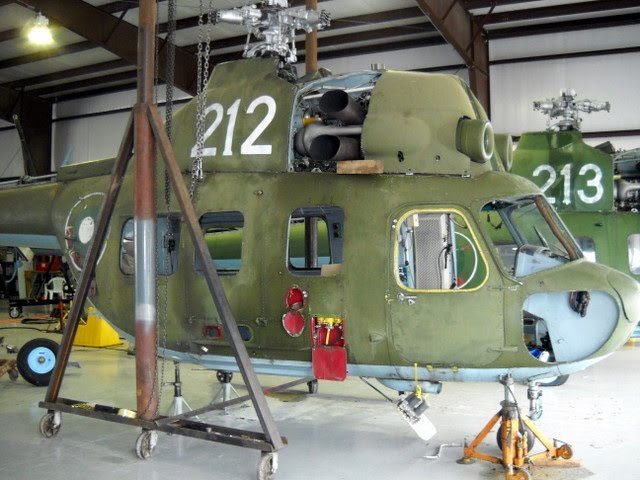
Returning to flying status after quite a few years on the ground, the Cold War Air Museum's third Mil Mi-2 "Hoplite" aircraft, bord 212, received it's airworthiness certificate today.
Directors Pete Coz and Jon Boede hold the latest FAA Airworthiness Certificate in front of the newest fully restored aircraft at the Museum.
Having multiple Mi-2s and pilots to fly them, allows the museum to respond to more requests for aircraft at airshows and events throughout the year.
Congratulations to all our volunteers and associates for their efforts in making this project another success at the Cold War Air Museum.
Showing posts with label Bord 212. Show all posts
Wednesday, June 22, 2011
Saturday, June 11, 2011
During the last FAA visit to the Cold War Air Museum, we picked up several action items for the completion of our Mi-2, bord 212.
One of them was adding dataplates (labels) to the panel and matching everything together in the new Pilot Operating Handbook (POH).
Jon, the detail oriented member of the group, studied the panels and requirements to send the necessary dimensions and details to the engraver.
The report for this week is; the POH update is nearly complete and the dataplates are on their way back from the engravers.
We're almost there!
One of them was adding dataplates (labels) to the panel and matching everything together in the new Pilot Operating Handbook (POH).
Jon, the detail oriented member of the group, studied the panels and requirements to send the necessary dimensions and details to the engraver.
The report for this week is; the POH update is nearly complete and the dataplates are on their way back from the engravers.
We're almost there!
Sunday, March 14, 2010
Mil Mi-2 Restoration Work Continues
Among the many projects at the Cold War Air Museum is the restoration of our Mi-2, Bord 212. When completed, we will be applying for airworthiness certificates for both 212 and 213 to join 211 on flying status.
As previously reported during the restoration of Bord 211, we have had to deal with some corrosion in these aircraft. For previous details, click on the labels at the botttom of this article to follow the various story threads.
After the fuel bladder was removed, cutting the old metal away exposed the fuel compartment. Areas within the compartment were inspected and treated as necessary.
The old skin was used as a template for all rivet and access panel hole locations to be traced onto a new piece of aircraft aluminum.
Charles then carefully cut and trimmed the new piece for a perfect match.
After the external strengthening pieces ("Hats") were riveted in place, the rivet tails on the inside were covered with Polykin tape to protect the fuel bladder.
Both the inside and outside were treated and coated before the hats and doublers, seen here in contrasting color, were reattached.
We expect the next step, "shooting" (riveting) the skin back on, will take place soon.
As previously reported during the restoration of Bord 211, we have had to deal with some corrosion in these aircraft. For previous details, click on the labels at the botttom of this article to follow the various story threads.
After the fuel bladder was removed, cutting the old metal away exposed the fuel compartment. Areas within the compartment were inspected and treated as necessary.
The old skin was used as a template for all rivet and access panel hole locations to be traced onto a new piece of aircraft aluminum.
Charles then carefully cut and trimmed the new piece for a perfect match.
After the external strengthening pieces ("Hats") were riveted in place, the rivet tails on the inside were covered with Polykin tape to protect the fuel bladder.
Both the inside and outside were treated and coated before the hats and doublers, seen here in contrasting color, were reattached.
We expect the next step, "shooting" (riveting) the skin back on, will take place soon.
Thursday, January 7, 2010
Mil Mi-2, Bord 212 work continues
As we have previously done with the Mi-2 currently flying at the Cold War Air Museum, we are having to replace a portion of the belly skin that was damaged by corrosion on helicopter number 212.
Work is progressing at a good pace. The bottom skin has been removed and the interior of the fuel compartment will be cleaned and treated before it is closed up again.
The old damaged skin will be placed on top of a new sheet of aircraft aluminum so that all dimensions and holes can be carefully traced out.
After all the dimensions are transferred, Charles turns the new sheet into a perfect match for the old.
As work progresses, we will continue to bring you update reports.
Friday, November 27, 2009
Mil Mi-2, Bord 212 next up
At the Cold War Air Museum, we're getting a lot of experience with our Mi-2s. We learn as much as we can from former field and factory techs that contact us and visit. You can share your experience and stories by contacting us at the museum as others have done.
Our local techs and mechanics have also applied lots of their experience at dealing with problems that occur in aging aircraft everywhere. Opening and inspecting the fuel bay for corrosion is now a standard procedure for Charles. We are fortunate to have his experience and skills. Sometimes we don't know what we must deal with inside until we get down to bare metal.

Getting down to the bare metal requires quite a bit of work and and if there are indications it is necessary, we also remove the external stiffeners (hats) to inspect the area beneath.
After evaluating the work to be done, to patch or replace, the decision was made to replace a section of the skin on 212 as we did with Bord 211. This requires suspending the Mil so we can safely remove more of the structure. Work is proceeding as shown in the earlier posts on Bord 211.

Getting down to the bare metal requires quite a bit of work and and if there are indications it is necessary, we also remove the external stiffeners (hats) to inspect the area beneath.
Subscribe to:
Posts (Atom)