Showing posts with label Bord 022. Show all posts

Thursday, August 11, 2011

MiG-23 Twilight Afterburner Run

On Saturday the Cold War Air Museum performed a twilight taxi test of its MiG-23UB "Flogger" aircraft.

The following photographs are provided courtesy of Ivan Voukadinov, who made the trip from Chicago for the event. Ivan is from Bulgaria, where his uncle was a Bulgarian Air Force pilot who flew our Bord 022 during its military career.


Photographers and movie makers refer to the time that straddles sunrise and sunset as "Golden Hour" because the natural lighting has a certain glow to it.


15 minutes after sunset, the MiG-23 was taxied into position on the runway and the afterburner was lit for approximately 3.5 seconds. The initial afterburner ignition is the most impressive because of the sheer volume of raw fuel that is sprayed into the tail pipe. The MiG-23 consumes approximately 2 gallons of Jet-A per second at max afterburner.


After slowing down and leaving the runway, the wings were swept to the 72° position, giving the Flogger its signature "go fast" look.


The MiG-23's appearance is even more menacing after dark. Taxi lighting consists of illumination on both sides of the aircraft. The landing configuration consists of illuminating only the larger light on the port side of the aircraft as Soviet pilots were taught to "look left" during landing.


The MiG-23 was the first Soviet design that took cockpit ergonomics into strong consideration and the internal lighting is particularly well thought out.


Even sitting still the MiG-23 looks like it's going Mach 2.35.


Many thanks to Ivan and all the other photographers who made it out to the museum!

Sunday, April 10, 2011

MiG-23 Progress

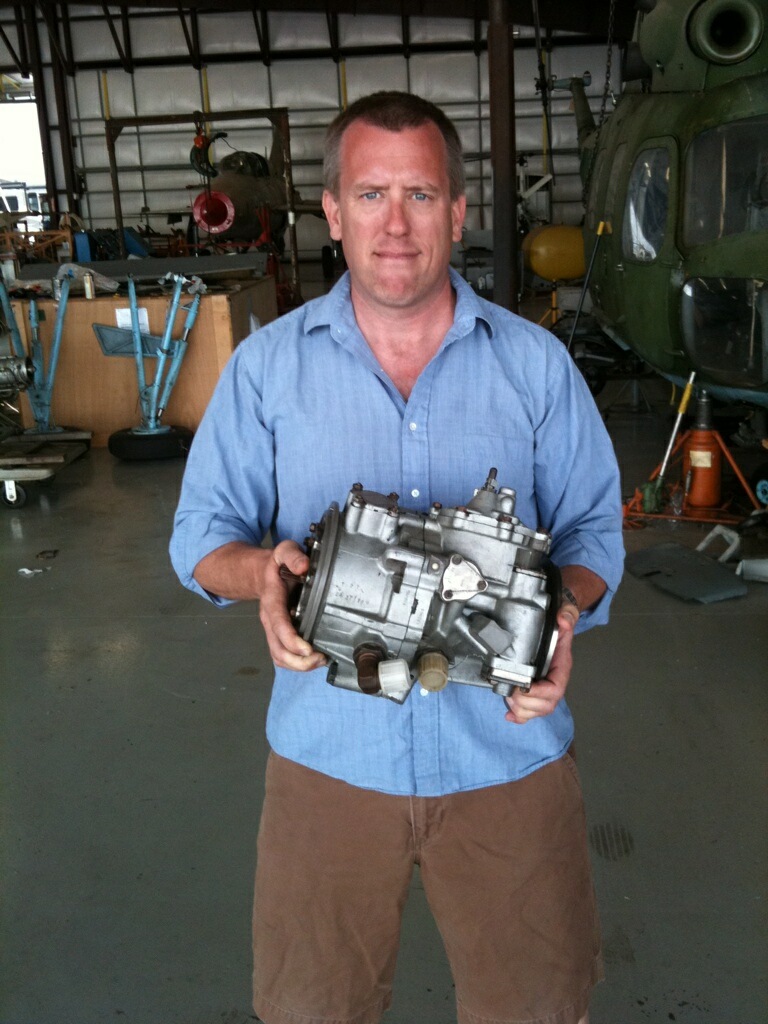
One of the more interesting components of the MiG-23 is the PGL-30M Hydraulic Powered Speed Regulator, a device that uses fuel to feed a vaned drive which in turn powers the AC generator.

Rather than using a complicated gear reduction mechanism to drive the AC generator from the engine rotation, the designers at MiG decided to use fuel pressure through a fluid labyrinth to obtain the constant RPM needed by the AC generator.

This works beautifully, producing a constant (plus or minus 2%) RPM... except when the PGL-30M leaks. Of course, when it leaks, it leaks fuel, which is the case with the Cold War Air Museum's MiG-23.

The MiG-23 doesn't do anything in a small way when it comes to fuel. Until the device was removed it was necessary to put a 150 gallon plastic stock tank under the aircraft to catch the drip.

Here Jon holds the leaking PGL-30M, the grimace on his face evidence of the fact that the device is even heavier than it looks.

The museum has located a replacement regulator, which we expect to be arriving in the near future.

Tuesday, October 12, 2010

MiG-23 Work Resumes

Work has resumed on the Cold War Air Museum's MiG-23UB.

As readers of this blog may know, the Flogger developed a mysterious fuel system leak after ground test in the spring. Replacement parts have now arrived allowing us to resume.

Here are a few photos of the inspection work:

With some clever modification a MiG-23 engine dolly can be made to work as a MiG-23 tail dolly. We were able to pull the tail back to expose inner connections of the single-point fuel port. Interestingly, a US/NATO single-point connection fits perfectly on the Soviet aircraft.


Initially we put 25 liters of fuel into the single-point connection and got 20 liters on the floor. With some fixing, we put 125 liters in and got only 0.5 liters to leak out. Hopefully with some new o-rings the leak will be completely fixed.

The museum's goal is to have the MiG-23 ready for more ground testing, including a test of the afterburner, some time this month.

Friday, February 26, 2010

Anatomy of a MiG-23 Caution and Warning Panel

While the original Cyrillic Russian in the MiG-23's cockpit is authentic, if a red light comes on in the cockpit, we'd like it to come on in English. Labeling and placarding the cockpit for safety, and changing the altimeter from meters to feet are some of the steps necessary before we can fly the aircraft in U.S. Airspace.

The MiG-23 is part of the first generation of Soviet aircraft where cockpit ergonomics were given major consideration in the design. The layout is clean and logical but at the cost of increased complexity of the mechanical "switchology".

Like the rest of the MiG-23, the Caution and Warning panels are rugged and well thought out. The main panel shown here can be removed with a single screw, making it easy to change the 28v light bulbs behind it. The "day/night" knob adjusts the brightness of the lights and doubles as a "push to test" button that illuminates all bulbs so the pilot can check if they're burned out.


Here the panel is seen from the back with encapsulation for each light bulb so that there is no "light bleed" from one indicator to the next. The brightness adjustment knob carries through the "push to test" action to a button behind the panel. A spring returns the knob to its normal position.


The panel is continuously adjustable from fully bright "day" mode to a very dim "night" mode. Unusually, this is done with a mechanical slider that blocks the amount of light coming to the panel rather than by regulation of the voltage intensity being applied to the lights.

The slider is shown in this photo in both the fully open and fully closed positions.


The first step to converting the panel to English is to document the existing panel both for the museum's records and to facilitate translation to English terms that are familiar to pilots.

There are two primary panels, one dealing with engine issues and one primarily dealing with the six fuel tanks (plus external drop tanks) that are automatically managed for the pilot. Additionally, a panel of "trim neutral" green lights and a set of information lights on the gear tree need to be translated.

The MiG-23's unique "swing wing" design is brought up on the panel's "SPREAD WINGS" light. As it is virtually impossible to land the MiG-23 with the wings swept to any degree at all this light exists to alert pilots to the danger that the gear have been lowered and the wings are not in the full forward position.


The designers at MiG chose a panel construction that easily lends itself to conversion to English while retaining the "feel" of the original panel.

Each indicator consists of a seven-layer sandwich of frosted tiles, the label with the wording on a thin "film", copper gaskets to provide a snug (vibration proof) fit, and a glass "color" tile that is red, yellow, or green as relates to the urgency of the information being provided to the pilot. Red tiles illuminate for emergency situations (fire, loss of an electric generator, or very low fuel state), yellow for situations needing the pilot's attention (hydraulic system anomalies), and green for information not requiring action (such as when a fuel tank reaches an empty state).

Additionally a master caution annunciator and two red master caution lights are placed in the pilot's "heads up" field of view. The blinking of the master caution system can be canceled by pressing the master caution annunicator light/button.


After some discussion on translation, a final panel is created with Inkscape for laser printing on transparency film. Here Jon is shown with the translated film and scissors on the, "You want to fly it, you cut them out!" plan.

Monday, February 15, 2010

MiG-23 Tire Change

Following the taxi test of the MiG-23 at the Cold War Air Museum during Soviet Big-Iron Saturday, we began noticing that the port tire was losing pressure. We had anticipated replacing the tires that came with Bord 022 and fortunately, our replacement set was already on hand.

A particularly handy thing is to keep a spare tire already mounted on a spare rim to minimize the time needed to "rescue" an aircraft in case a tire should "blow", or go flat during operations. One of our "spares" was already mounted on a rim, simplifying this replacement process.

However, this did not eliminate the need to read the instructions. The MiG-23 wheel assembly consists of approximately 60 individual components, not including nuts and washers (so much for Soviet Simplicity, this time anyway). Here Jon is seen trying to figure out what does and, more importantly, does not need to be taken apart in order to replace the wheel.

The massive disk brake mechanism incorporates an anti-skid system and uses six big rotors and seven heavy-duty stators in each wheel.

The amount of heat that can be generated by the brakes poses a serious bursting issue with the tires. To prevent this, the designers at MiG incorporated two interesting features. The first is an electric fan. Mounted in the center of the axle, the fan activates when the "weight on wheels" switch signals that the aircraft is once again on the ground.

Shown with the axle fan is the nut that holds the wheel on. A keeper ring goes between the fan mounting bolts and the axle to keep the fan and the nut from turning as the tire turns. In the picture below, Jon is inspecting the electrical connection for the fan motor in the center axle.

The second feature is a solder plug that melts at 140°C, allowing pressure to escape before the tire can burst. On fast landings or after any extensive brake use, MiG-23 pilots may alert their ground crews so the wheels can be doused with water so the plug doesn't melt.

Sliding the tire on over the six rows of rotors is a little like working a combination lock, but with a little light on the subject and some patience, Jon and Sean were able to get the tire on fairly easily.

All that remains is re-mounting the mud guard, applying safety wire and cotter pins to various keepers, and... of course... next, the replacment of the starboard tire.

Monday, January 25, 2010

Soviet Big Iron Saturday

A "flying" museum, like the Cold War Air Museum must exercise their aircraft, or at least the engines and systems on a regular basis.


Saturday was a work day for our many volunteers and supporters. A number of aircraft were brought out for engine start and exercise.


The Mi-2's and Mi-24 are run up on a regular basis.


Starting the Mi-24 can be exciting. The aptly named Saphir APU has a tendency to blow out any excess fuel during its start cycle. The sight and sound is impressive. Once again, our thanks go to Miguel for this outstanding picture. This picture and a number of others can be found as a desktop display on the "wallpapers" page at the museum main web site.


Fuel sales for the "big iron" help support the airport.


Visitors commented that it felt like they were on a Soviet air base. For a short time Saturday, that feeling was understandable.


The MiG-23 is still undergoing restoration while the L-39's at the museum fly regularly.


With local and world-wide coverage from our web sites, we often gain new associates. One of our new associates is a former Russian pilot and MiG-23 instructor who is currently employed at a major flight training center at DFW. He is a big help with systems knowledge and practical experience in the MiG-23.


Vadim and Jon debrief their MiG-23 taxi test.


The MiG-23 looks like it's going supersonic, just standing still.


The massive R27-F2M engine in the MiG-23 makes a wonderful, unmistakable howl as the power comes on.


No Mud Today! Just lots of happy noise from turbines turning and burning, consuming Jet-A.

Saturday, December 5, 2009

MiG-23 Walk Around

Our Cold War Air Museum MiG-23 got a walk around with Ben (one of our valued language and technical resources) and Jon asking questions about the aircraft.


Our thanks to Ben, Jon and various associates for putting this together. Special thanks go to Kazik, our favorite "James Bond Villain" stand-in, for taking time out from his visit to help us and to Taylor for his excellent job of filming and editing under adverse conditions.

Sunday, November 8, 2009

Bulgarian VVS Photos

Ivan Voukadinov recently visited the Cold War Air Museum and took quite a few pictures. Ivan is from Bulgaria and has kept up with the fate of many of the aircraft that were formerly in BVVS service. He's graciously joined the blog team and agreed to provide some back story on many of the museum's aircraft.

Ivan has already researched and emailed us some photos of our aircraft in Bulgarian service.

More pictures of the museum's aircraft including pictures of the L-39, Mi-2, Mi-24, and MiG-23 have been posted to the museum's Main web site. We hope also to hear stories from some of the pilots and crewmen of these fine machines during their VVS or Bulgarian Air Force days.

Thanks Ivan!

Wednesday, November 4, 2009

MiG-23, Trick and Treat

October 31st, the day these pictures were taken was Halloween or "All Hallows Eve". Kids run around yelling "trick or treat" and expect some candy or they will play a trick on you. Our day started off with a "trick" as soon as we rolled Bord 022, our Cold War Air Museum, MiG-23, out of the hangar.

We told the story previously about all the rain we've had. Some of that rain may have weakened the fill under an area of our ramp, allowing the left wheel to break through the surface. Since this was the same side that sank in the mud earlier, a reader asked if the plane was heavier on that side (No). After lifting the plane and patching the ramp, we were soon again on our way.


With no further problems, Jon "piloted" the bird out to a clear area of the ramp, taking care to place her as far as practical from the most active taxiway and with the blast area directed away from parked aircraft. (Jon, I don't think this counts as "PIC" time).

With the aircraft in a safe area, it was time to give her a "treat", some Jet-A. The massive quantities of liquid hydro-carbons this bird consumes will soon be moving the museum into a whole new area of fuel purchase experience. Note the shadow with the wings full aft!


After a successful start up, all movable control surfaces were exercised. Note the flap and slat deployment. From this angle it is hard to get the full effect of seeing the wings swing. Look at the shadows on the ground to help see the movement from full extension to aft positioning.


With the wings tucked back, it was time to bring up the power. An afterburner run-up is not possible with just brakes and chocks holding the aircraft. The front strut is depressed in this run-up to 100% power, just shy of first-stage afterburner.

After shut down, one of the techs went over to check the tail. Like puppies, everyone else followed.

There must be something fascinating about looking at aircraft tails. At most airshows and at all of our student events, the boys always come around to look. Everyone seems to want to try and figure out how this hole can turn up to $12.00 worth of hydrocarbons into hot air every second. Perhaps they are seeking to understand how a segment of the American economy accomplishes similar (but much more expensive) results without being nearly as entertaining.

Sunday, November 1, 2009

MiG Videos, mud run

Our first day out with the Cold War Air Museum, MiG-23, was exciting.

Both for what we expected to go right, like starting the APU and the Engine and testing the hydraulics (wings, controls, etc.) as well as what we didn't expect, like running off the taxiway into the mud.

We are happy to report that there was no damage to the aircraft (or anyone or anything else) and as reported in the previous blog, we had the aircraft out of the mud in relatively short order.

When it comes to building an aircraft and landing gear with the expectation that sooner or later it is going to get stuck in the mud, there are probably no better qualified and experienced design bureaus around!

Friday, October 30, 2009

MiG Mudding

In Texas, it can be Sunny, Rainy or Snowing, sometimes all in the same day! In continuing our progress on the Cold War Air Museum, MiG-23, the guys took advantage of a brief respite in our recent rains to roll out Bord 022 and do some tests. APU start? Check. Engine start? Check. Brief taxi run? Check. Gear in the Mud? Check.

As we get older, we continue to find that life is a series of learning experiences. Because of the recent rains, the gear quickly bogged down in the soft ground beside the ramp. With the co-operation of the airport management, who NOTAM'd the taxiway out of service, we called our friendly crane company who happened to have the needed equipment just down the road. These guys have assisted in the past with rigging and lifting, especially when we have off loaded the aircraft on arrival (see the Mi-24 coming out of the box and the Mig-23 coming out of the box).

With a quick lift, we were soon back in the hangar, although some of the "boys" were covered in good Texas mud (and a bit of chagrin). And while the taxiway was temporarily closed, the local police department took the opportunity to come out and practice using "Stop Sticks". With the locals checking the moorings on their Arks the day before and the day after, we picked a good day for everyone to get outside and enjoy the Texas weather.


When we took a poll of associates about publishing a potentially embarassing story, the response overwhelmingly was positive, after all that's what blogs are for, and look what we've accomplished, we've assisted local law enforcement and provided a stimulus package for the local economy through fuels sales and crane rental. Or, as another associate summarized:

Fuel Purchase ----------------- $xxx.xx
Crane Rental ------------------ $xxx.xx
Getting Stuck in the Mud ---- Priceless!

We will have videos of the happier and drier portions of this exercise posted soon and with the skies once again blue and clear, we hope to have more stories to tell and video to post after the weekend.

Monday, October 26, 2009

MiG-23 progress

At the Cold War Air Museum, we are again working on the MiG-23.

The 23 has an unusual ventral fin for added stability in flight. Here it is shown retracted to the side so that it does not scrape the ground on landing or take off. Fin retraction is tied to the landing gear system. It automatically extends when the gear is retracted and retracts when the gear is extended.

We were able to see this (and a lot of other things as well) while checking some of the hydraulics and the gear system yesterday. Sean, one of our volunteers, captured several clips of the gear and ventral fin and provided them to us for the blog. Thanks Sean!

At the beginning of this clip the gear is being retracted and the ventral fin can be seen moving to the down position. Almost immediately the gear is extended again as the camera shifts to a different view. Upon full extension, the view quickly shifts to the tail to show the fin flipping back to the side again.


A young man recently visiting the museum called the MiG-23 a "Transformer" plane. Like the action figure series, it has lots of large moving parts and is capable of some pretty fancy reconfiguration. The clip below shows another view where at first you can almost imagine a mechanical arm reaching out from some large mechanical war machine. Oh yeah, in reality, that's pretty much what it is.


The video continues long enough to again show the ventral fin changing position under the tail (the "click" noise associates with the fin unlocking to change position).