The Cold War Air Museum derives its name from the era between the end of WWII and the breakup of the Soviet Union. In a series of speeches and visits during his second term, American President Ronald Reagan challenged the Soviets to end that era and tear down the physical and trade barriers separating Eastern and Western Europe. Many historians consider the fall of the Berlin Wall as the "beginning of the end" of the Cold War.
Twenty years ago this week, on November 9th, 1989, free travel was again established between the Eastern and Western sectors of Germany. In celebration and remembrance of this event, we offer the following link to President Reagan's speech at the Brandenburg Gate challenging Soviet President Mikhail Gorbachev to end the Cold War.
President Reagan was one of our most popular and charismatic leaders. This speech is a window on that time. The Cold War Air Museum is seeking items and artifacts of the era for exhibits.
One of our friends "from the other side" sent us this image, to the effect that the wall may be gone but a chasm still remains.
October 31st, the day these pictures were taken was Halloween or "All Hallows Eve". Kids run around yelling "trick or treat" and expect some candy or they will play a trick on you. Our day started off with a "trick" as soon as we rolled Bord 022, our Cold War Air Museum, MiG-23, out of the hangar.
We told the story previously about all the rain we've had. Some of that rain may have weakened the fill under an area of our ramp, allowing the left wheel to break through the surface. Since this was the same side that sank in the mud earlier, a reader asked if the plane was heavier on that side (No). After lifting the plane and patching the ramp, we were soon again on our way.
With no further problems, Jon "piloted" the bird out to a clear area of the ramp, taking care to place her as far as practical from the most active taxiway and with the blast area directed away from parked aircraft. (Jon, I don't think this counts as "PIC" time).
With the aircraft in a safe area, it was time to give her a "treat", some Jet-A. The massive quantities of liquid hydro-carbons this bird consumes will soon be moving the museum into a whole new area of fuel purchase experience. Note the shadow with the wings full aft!
After a successful start up, all movable control surfaces were exercised. Note the flap and slat deployment. From this angle it is hard to get the full effect of seeing the wings swing. Look at the shadows on the ground to help see the movement from full extension to aft positioning.
With the wings tucked back, it was time to bring up the power. An afterburner run-up is not possible with just brakes and chocks holding the aircraft. The front strut is depressed in this run-up to 100% power, just shy of first-stage afterburner.
After shut down, one of the techs went over to check the tail. Like puppies, everyone else followed.
There must be something fascinating about looking at aircraft tails. At most airshows and at all of our student events, the boys always come around to look. Everyone seems to want to try and figure out how this hole can turn up to $12.00 worth of hydrocarbons into hot air every second. Perhaps they are seeking to understand how a segment of the American economy accomplishes similar (but much more expensive) results without being nearly as entertaining.
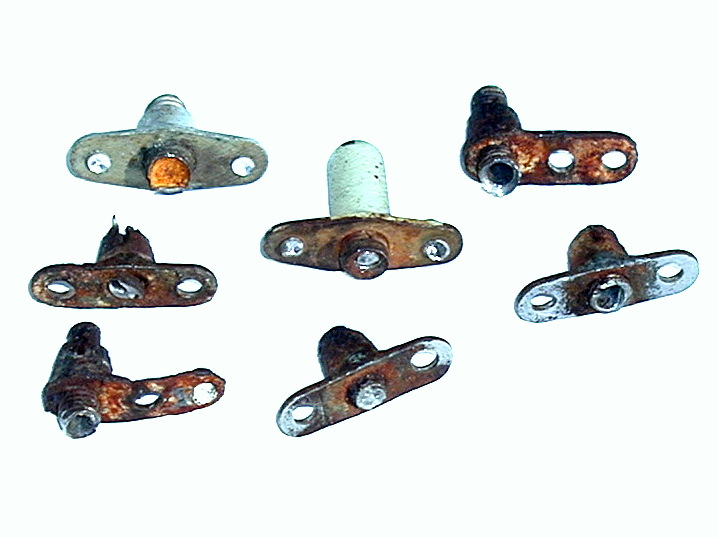
Help is needed to locate a source for nutplates for the MiGs!
In an earlier post we talked about the harsh conditions these aircraft lived under and how we had to drill out many of the skin fasteners that had rusted in place.
These fasteners may be called nut plates in the U.S. or anchor nuts overseas, but whatever you call them, the sizes we encounter in the MiGs and Mils do not match current U.S. or European rivet hole spacing. We have tried several different sources with no luck. All say "sure, is no problem" and then send us something they think we want. Our problem is we need "what was", not "what is". We finally talked to a mechanic who told us "Yes, he was sure there was a warehouse full of thousands of what we needed somewhere". But, someone would have to just go around looking until they found what we were looking for.
We were fortunate to find 25 pieces called out as AM5GB630 that were a perfect replacement for the 5mm double lug parts we need. We and our supplier thought that he could get more, but alas that was not to be. It turns out that he had bought a thousand "from a Russian warehouse" several years ago and these were the last 25 of those thousand. When he called back, he found there were no more to be had and now he has an aircraft of his own waiting on these very same parts to be repaired. When we find some, he needs some back!
Here's a challenge for all our Cold War Air Museum readers. Below are pictures and drawings of the parts we. need. Most importantly, we need the 5mm single and double lug non-capped fasteners. If someone knows where fasteners of this vintage can be found we would be very, very grateful. In the same series, we have a lesser need for other sizes as well.
You can contact us by using the comment link below or email us through the contact page on the main museum site. Thank you!
5mm Single Lug, above
5mm Double Lug, above
This is your mission, should you choose to accept it. This Blog will self-erase upon completion of this mission. Cue Theme music here - dum dum, da da, dum dum, de de ... etc.
Both for what we expected to go right, like starting the APU and the Engine and testing the hydraulics (wings, controls, etc.) as well as what we didn't expect, like running off the taxiway into the mud.
We are happy to report that there was no damage to the aircraft (or anyone or anything else) and as reported in the previous blog, we had the aircraft out of the mud in relatively short order.
When it comes to building an aircraft and landing gear with the expectation that sooner or later it is going to get stuck in the mud, there are probably no better qualified and experienced design bureaus around!
The Cold War Air Museum is a 501(c)3 non-profit organization dedicated to the restoration and maintenance of Cold War era aircraft with a special emphasis on aircraft flown by the former Soviet Union.
Most of the museum's 20+ aircraft are in flying condition or being made ready for flight.
The museum is located on Lancaster Municipal Airport, twenty minutes south of Dallas, Texas. The museum has tour hours of 10am to 4pm on Saturdays but is open all day most weekends. There is a cafe on the field that serves a full breakfast and lunch menu.