Thursday, May 26, 2011

Cold War Air Museum at the Corsicana Air Show - Part 2

We've got a few more pics to share from the Cold War Air Museum visit to the Corsicana Airshow this year.

The Mi-2, as well as the Mi-24 drew plenty of interest.

Because the helicopters were perfectly happy to operate off the grass. More ramp area was made available for the fixed wing aircraft that needed a hard surface to park and taxi.

As Jon taxied by in the L-39, Andy got this shot of the Mils starting to develop lift power (and a UH-1 in flight behind them).

The top speed of the Mi-24 is well within the low end of the L-39's operational envelope, so Andy took several in-flight pictures of the Mil during his ride back to home base.

Thanks to Andy Nixon for sharing these additional photos with us.

Tuesday, May 24, 2011

MiG-21 Work Continues

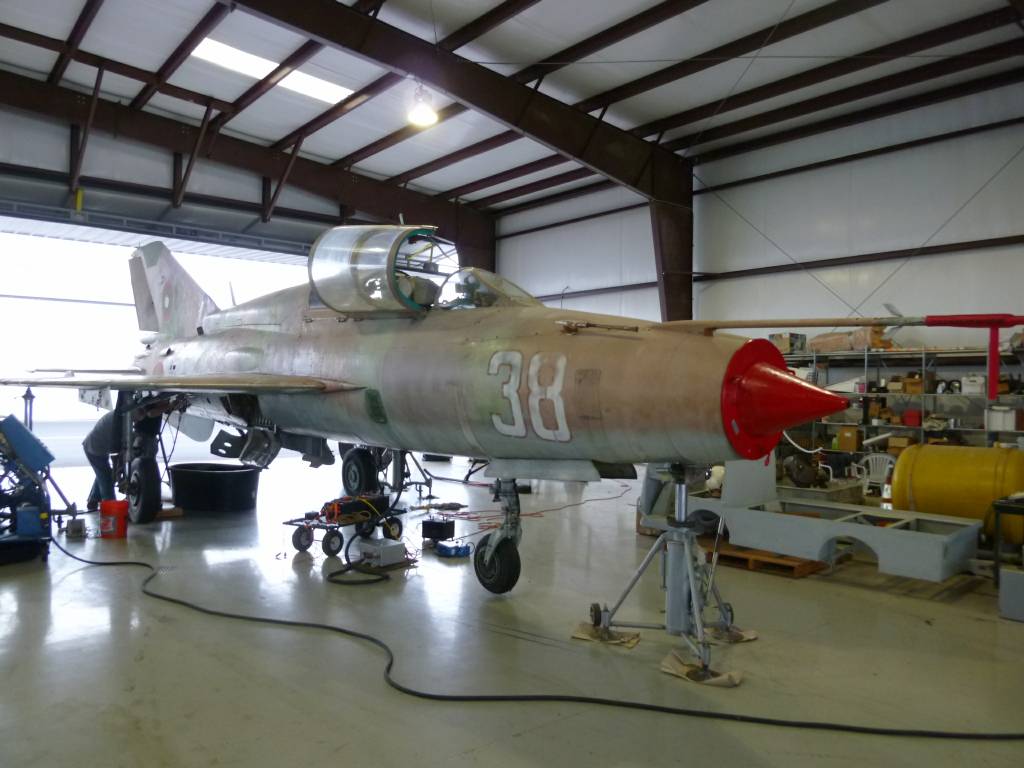
MiG consultants for the Cold War Air Museum  are in town working on our MiG-21UM and MiG-23UB.

On jacks, Bord 38 is about to go through gear retraction and extension cycles. Our external "mule" allows the hydraulic system to be isolated and checked before we move on to testing the engine. Ground tests are an important milestone in the restoration and certification process.


Improvisation is sometimes necessary. A few litres of hydraulic fluid needed to be injected into a hydraulic reservoir through this service port, so we modified a bug sprayer from the local hardware store to do the job. Kazik shows us how it's done.


Meanwhile, Roman inspects the connections and cannon plugs under the MiG-21's wheel well.


Our goal for this month is to get the hydraulic systems on the MiG-21 tested and the engine started so the aircraft can be taxied under its own power.

Sunday, May 22, 2011

Aircraft Registration Marks

Part of the process of getting an aircraft at the Cold War Air Museum ready for certification is complying with the external marking requirements of the Federal Aviation Administration (FAA).

FAR 45.22 provides a few things that are unique to Experimental Exhibition aircraft:

1) "N numbers" can be as little as 2 inches tall and;

2) Instead of the word "EXPERIMENTAL" on the outside of the aircraft, an X can be placed in the second digit of the "N number" to identify the aircraft in the experimental category.

These concessions allow an aircraft to be displayed close to its original military markings, without as many visual distractions. After going through this ordeal with his own plane, one of the museum benefactors bought a stencil machine to help us with this process and Jon has provided some pictures and a description from one of the current projects, below.

First, the stencil must be designed using the vinyl cutting program. Stencil material can be up to 15 inches wide and the image can either be "positive" (blocking paint from the surface), or "negative" (the stencil is painted over and then removed, leaving a painted image behind).


Here, a "negative" is applied to the aircraft.


Then masking is added to limit over-spray on the rest of the aircraft and the floor.


And paint is applied.


Finally, the stencil is removed. Some experience is helpful at this step, as the paint must be dry enough to leave clean edges but not so dry that it pulls up with the stencil.


The result is a very nice "N number" of precisely the desired size and style.

Watch for more updates on this aircraft in the near future!

Tuesday, May 17, 2011

CWAM at the Corsicana Airshow, Part 1

The Cold War Air Museum gets a fun opportunity to participate in the Corsicana Airshow every year.

The crowds enjoyed seeing our aircraft as well as a great many others.

Big kids and little kids are always fascinated to see flying machines, especially the Mi-24.

With the B-17 flying overhead and lots of other activities, there was plenty to see, hear and do.

Including getting your picture taken by our friendly guys.

The L-39 was a hit as well. With the price of fuel being what it is today, it is more of a burden for turbine aircraft owners to attend shows.

Old and new, a view of the B-17 on approach from the L-39 rear seat.

Thanks to Andy Nixon for sharing these fun photos with us. We'll have more soon in Part 2 of this series.