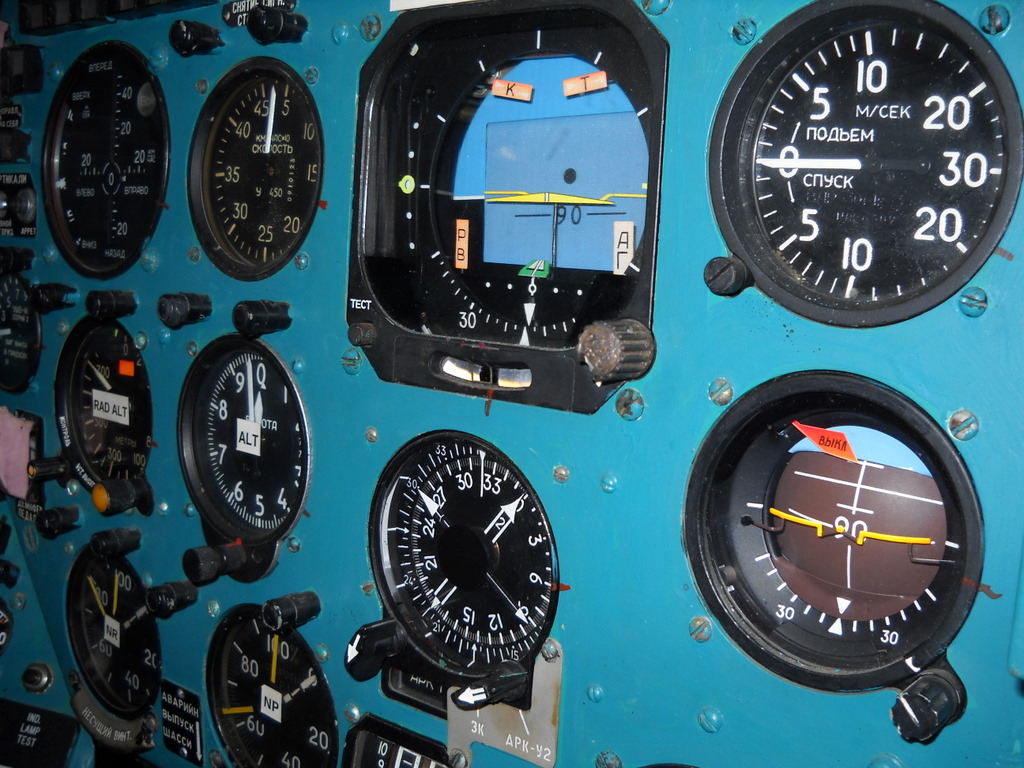
A topic of discussion for visitors at the Cold War Air Museum has been; "What color is that?" Or; "Why did the Soviets paint their cockpits green?"
Model making web sites have frequent questions and discussions about getting the exact color of soviet aircraft cockpits, exactly right.
Fortunately, we have the advantage of having the "real thing" with which to compare. We have been told that the color chosen by Soviet designers helps to reduce stress and maintain a pilot's effectiveness on long missions. While the Soviets were not the only country (or manufacturer) to use this color, they have used it for so long and in such great numbers that it has become a trademark of Sov-block aircraft.
Because not all aircraft are painted at the same time, or at the same place, there is some inevitable variation in color. Some aircraft have more of a green tone.
And, some have more of a blue tone, even when the aircraft come out of the same factory in the same country. In general though, the description "blue-green" seems to fit slightly more of the aircraft we see (especially the newer ones), than the alternate description often given as "light green".
These three panels, or sections of panels from different aircraft, show some color variation even though all three came from the same factory.
We don't worry too much about making an exact color match to some mythical factory standard, but we do make a color match for individual aircraft when necessary during restoration. Besides, we are mostly guys, and most of us simply made it through kindergarten with the 8-count box of crayolas, not the 64 count box (I don't even know how they come up with the names for so many colors). While the paint store most closely matched the blue-green above with a commercial color named "Mermaid Green", it's just not right to say "Our fighter cockpits are decorated in Mermaid Green". So for now, we'll just stick with something that fits within our limited repertoire and continue to refer to all of these colors as simply blue-green, or more simply as just that "Russian Cockpit Color".
Sunday, March 28, 2010
Wednesday, March 24, 2010
A Case for Models
The Cold War Air Museum has a number of volunteers who enjoy models and model aircraft construction.
This display case, one of several recently donated to the Museum, now houses a number of models of various cold war era aircraft, most of which have been brought in by our most prolific volunteer modeler, Sean.
As time goes on, more model aircraft will be added and it is likely that display groupings will be re-arranged by era and aircraft scale.
The Mil-8 and MiG-15 are examples of aircraft that we may eventually acquire or display. Later model Soviet aircraft rarely make their way into the "States".
The display case is located in a hallway adjoining the main Museum display area. The hallway is well lined with windows for viewing. Reflections counterpose the models on display with the real aircraft on display.
An earlier post told of the intention to create model versions of all of our aircraft on display. That is still an ongoing project.
This display case, one of several recently donated to the Museum, now houses a number of models of various cold war era aircraft, most of which have been brought in by our most prolific volunteer modeler, Sean.
As time goes on, more model aircraft will be added and it is likely that display groupings will be re-arranged by era and aircraft scale.
The Mil-8 and MiG-15 are examples of aircraft that we may eventually acquire or display. Later model Soviet aircraft rarely make their way into the "States".
The display case is located in a hallway adjoining the main Museum display area. The hallway is well lined with windows for viewing. Reflections counterpose the models on display with the real aircraft on display.
An earlier post told of the intention to create model versions of all of our aircraft on display. That is still an ongoing project.
Friday, March 19, 2010
Cold War Air Museum - Smiles
On the Cold War Air Museum blog, we try to include smiles whenever we can. If you look back through the stories, you will find many, many smiles, because it is easy to smile when you are having fun and enjoying what you do. Unfortunately, we don't always have room for all of the smiles we catch, so this post is dedicated to some of the smiles we've missed.
Our guys usually smile after making lots of jet noise.
The airport staff smiles whenever they sell us jet fuel.
Smiles during aircraft restoration help make the job go faster and easier.
Flying pretty girls always brings a smile to Jon's face. With apologies for the wind blown hair and the non-stylish parachute (but look, she is smiling too).
In fact, flying brings out the smile on most pilot's faces.
Kids and grandkids, we smile when they smile.
Our "significant others" smile cause they know where we are and what we're doing. The odor of jet fuel tells the tale when we get home.
It's hard to get some people to smile, but even with the most staid and business like, you can pick up a hint of a smile every now and then.
That's all for now. These smiles have been brought to you by the letters C,W,A and M. And that stands for Cold War Air Museum.
Thanks to everyone for their smiles, we plan on bringing you more smiles soon.
Our guys usually smile after making lots of jet noise.
The airport staff smiles whenever they sell us jet fuel.
Smiles during aircraft restoration help make the job go faster and easier.
Flying pretty girls always brings a smile to Jon's face. With apologies for the wind blown hair and the non-stylish parachute (but look, she is smiling too).
In fact, flying brings out the smile on most pilot's faces.
Kids and grandkids, we smile when they smile.
Our "significant others" smile cause they know where we are and what we're doing. The odor of jet fuel tells the tale when we get home.
It's hard to get some people to smile, but even with the most staid and business like, you can pick up a hint of a smile every now and then.
That's all for now. These smiles have been brought to you by the letters C,W,A and M. And that stands for Cold War Air Museum.
Thanks to everyone for their smiles, we plan on bringing you more smiles soon.
Sunday, March 14, 2010
Mil Mi-2 Restoration Work Continues
Among the many projects at the Cold War Air Museum is the restoration of our Mi-2, Bord 212. When completed, we will be applying for airworthiness certificates for both 212 and 213 to join 211 on flying status.
As previously reported during the restoration of Bord 211, we have had to deal with some corrosion in these aircraft. For previous details, click on the labels at the botttom of this article to follow the various story threads.
After the fuel bladder was removed, cutting the old metal away exposed the fuel compartment. Areas within the compartment were inspected and treated as necessary.
The old skin was used as a template for all rivet and access panel hole locations to be traced onto a new piece of aircraft aluminum.
Charles then carefully cut and trimmed the new piece for a perfect match.
After the external strengthening pieces ("Hats") were riveted in place, the rivet tails on the inside were covered with Polykin tape to protect the fuel bladder.
Both the inside and outside were treated and coated before the hats and doublers, seen here in contrasting color, were reattached.
We expect the next step, "shooting" (riveting) the skin back on, will take place soon.
As previously reported during the restoration of Bord 211, we have had to deal with some corrosion in these aircraft. For previous details, click on the labels at the botttom of this article to follow the various story threads.
After the fuel bladder was removed, cutting the old metal away exposed the fuel compartment. Areas within the compartment were inspected and treated as necessary.
The old skin was used as a template for all rivet and access panel hole locations to be traced onto a new piece of aircraft aluminum.
Charles then carefully cut and trimmed the new piece for a perfect match.
After the external strengthening pieces ("Hats") were riveted in place, the rivet tails on the inside were covered with Polykin tape to protect the fuel bladder.
Both the inside and outside were treated and coated before the hats and doublers, seen here in contrasting color, were reattached.
We expect the next step, "shooting" (riveting) the skin back on, will take place soon.
Subscribe to:
Posts (Atom)