Recent posts on the Cold War Air Museum Blog have featured the L29 and MiG-23, both "Gas Guzzlers" by the standard of the Hi Max below.
To say that the Hi Max is tiny compared to the MiG-23 is an understatement. Its fuel burn per hour is approximately equal to the MiG's fuel burn per second in burner.
One of the strengths of the Museum is the diversity of interests among the volunteers and associates that come together to share interests in flying, history and passing on that heritage to others. One of the associates previously featured, Homer Webb (principal at a local alternative high school), has adopted this beautiful little aircraft. With a fuel burn of only 2.5 gallons per hour, the jet guys can only mutter "it was a lot more fun when Jet-A was only a Dollar a gallon" (and some can remember when surplus fuel was only $0.10 per gallon).
Fast or slow, big or small, loud or not-so-loud, vertical lift or fixed wing, the Museum is a place where we all enjoy a common interest in flying machines, their operation, sharing their history and sharing with others stories of a time when so many of these machines were born. We are fortunate that Homer's willingness to accept and excel at challenges is typical of our group. Fly Safe Homer!
Saturday, April 16, 2011
Sunday, April 10, 2011
MiG-23 Progress
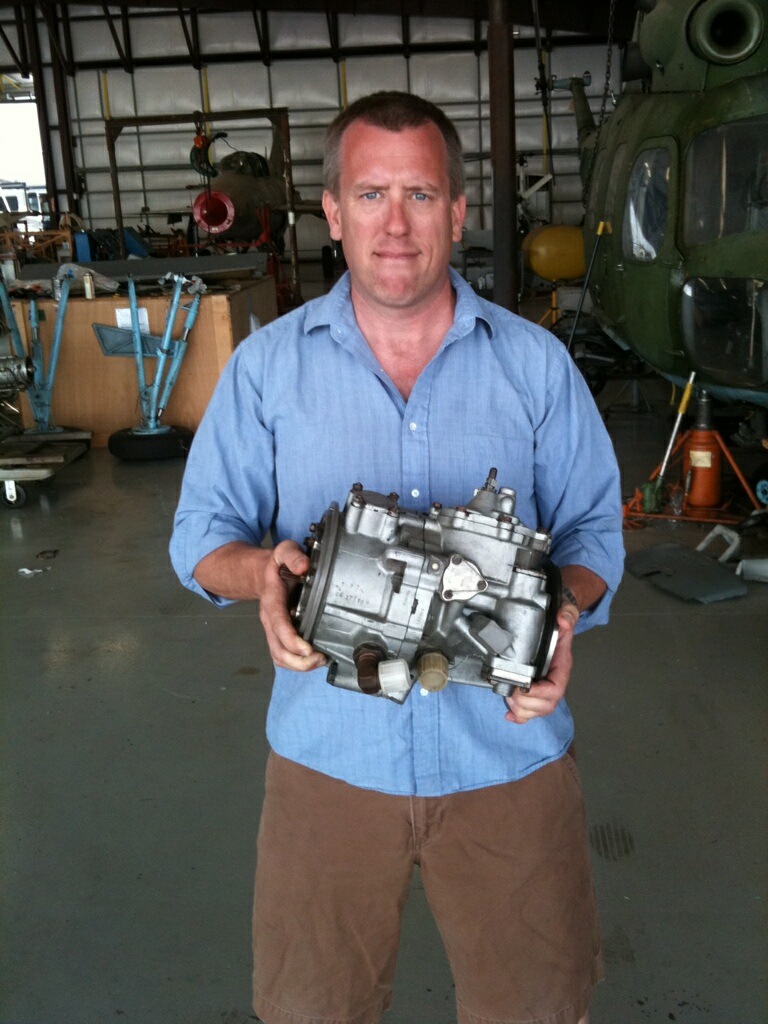
One of the more interesting components of the MiG-23 is the PGL-30M Hydraulic Powered Speed Regulator, a device that uses fuel to feed a vaned drive which in turn powers the AC generator.
Rather than using a complicated gear reduction mechanism to drive the AC generator from the engine rotation, the designers at MiG decided to use fuel pressure through a fluid labyrinth to obtain the constant RPM needed by the AC generator.
This works beautifully, producing a constant (plus or minus 2%) RPM... except when the PGL-30M leaks. Of course, when it leaks, it leaks fuel, which is the case with the Cold War Air Museum's MiG-23.
The MiG-23 doesn't do anything in a small way when it comes to fuel. Until the device was removed it was necessary to put a 150 gallon plastic stock tank under the aircraft to catch the drip.
Here Jon holds the leaking PGL-30M, the grimace on his face evidence of the fact that the device is even heavier than it looks.
The museum has located a replacement regulator, which we expect to be arriving in the near future.
Thursday, April 7, 2011
"Moving right along", an L29 story
A recent series of hanger relocation's around the Cold War Air Museum brought an L29 project temporarily out of storage.
One of the interesting stories for a future post is about how these aircraft were taken apart and shipped from their original homes to Texas.
The L29 divides easily into five major sub-assemblies, the nose, tail, wings, mid-section and engine (plus some extra parts).
The mid section, shown above, is the key puzzle piece. After you attach the nose, lower the gear and mount the engine, you have something that looks like a tricycle speed racer, useful for basic engine checkout and test. Wings, tail and a horizontal stab then complete the puzzle.
More than ten of these classic jet trainers have been reassembled or brought back to flying status with the assistance of the local group of fliers and mechanics.
The nose section contains the pressurized cockpit. Until the aircraft is reassembled, checked and certified, the owner can only sit inside and make loud "whooshing" noises. With today's fuel prices that sometimes seems like a desirable alternative even for the fliers.
Saturday, April 2, 2011
ArtSciencePhotos Contribution
Chris Williams, a new associate at the Cold War Air Museum is a frequent and welcome visitor.
His website, www.artsciencephotos.com displays some of his professional work. Chris recently came out and took some candid shots to share with us. We are looking forward to more contributions from Chris in the blog.
This shot caught a busy crew loading up the MD500 for a flight to North Texas on an animal population control mission.
And, they're off. The MD500 is a great performer, even with three big guys and all their gear.
The hunt was fun for all even though the wily animals did not put in their expected appearance.
The target rich environment for photographers at the Cold War Air Museum sometimes includes transitory populations of other interesting machinery. These tractors came from another fine collection and are temporarily being housed in some of the scarce spare space at the museum.
Knocking about the Museum, Chris and his special associate Bobbi got a rare opportunity to sample from the variety of tastes and interests on display. The Jets, Props, Helicopters and fixed wing aircraft are sometimes complimented by other vehicles and equipment on display, in storage, and in use.
A sepia tint seems just right for this shot of Bud and Jon in the Mutt ( See Warbirds on Parade for another picture of Phil's Vietnam era jeep). The tint makes the picture look older (and the passenger younger, thank you Chris).
And the R44 gets a rare appearance in the Blog with Renee in the cockpit. At a low sun angle, and partially back lit, Chris augmented the picture with some black and white technique to bring out more detail and drama.
Thanks Chris! We look forward to more contributions and an upcoming Blog post that will feature you and your good work.
His website, www.artsciencephotos.com displays some of his professional work. Chris recently came out and took some candid shots to share with us. We are looking forward to more contributions from Chris in the blog.
This shot caught a busy crew loading up the MD500 for a flight to North Texas on an animal population control mission.
Larry concentrates on his preflight cockpit checks in this colorful shot.
And, they're off. The MD500 is a great performer, even with three big guys and all their gear.
The hunt was fun for all even though the wily animals did not put in their expected appearance.
The target rich environment for photographers at the Cold War Air Museum sometimes includes transitory populations of other interesting machinery. These tractors came from another fine collection and are temporarily being housed in some of the scarce spare space at the museum.
Knocking about the Museum, Chris and his special associate Bobbi got a rare opportunity to sample from the variety of tastes and interests on display. The Jets, Props, Helicopters and fixed wing aircraft are sometimes complimented by other vehicles and equipment on display, in storage, and in use.
A sepia tint seems just right for this shot of Bud and Jon in the Mutt ( See Warbirds on Parade for another picture of Phil's Vietnam era jeep). The tint makes the picture look older (and the passenger younger, thank you Chris).
And the R44 gets a rare appearance in the Blog with Renee in the cockpit. At a low sun angle, and partially back lit, Chris augmented the picture with some black and white technique to bring out more detail and drama.
Thanks Chris! We look forward to more contributions and an upcoming Blog post that will feature you and your good work.
Subscribe to:
Posts (Atom)